Showing posts with label picture books. Show all posts

Saturday, February 12, 2011

Pirate picture books

My latest book order came in a week or two ago, and I've been slowly reading through all my new library books. I don't know how I managed it, but I kinda maybe sorta bought THREE picture books with pirates. Um, oops? I must have had Johnny Depp on my mind. Anyhow, here they are!

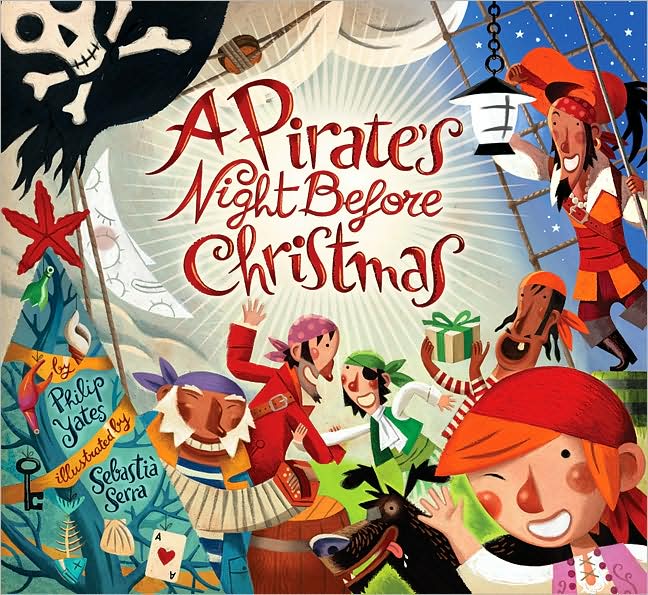
A Pirate's Night Before Christmas written by Philip Yates, illustrated by Sebastia Serra (2008)

Quite the retelling, this one is! It begins, "'Twas the night before Christmas aboard the Black Sark / Not a creature was stirrin', not even a shark!" I love the invented pirate rhymes, but I love more the pencil & ink digitally colored illustrations. They're soft, yet vibrant, and rather tropical because of course instead of reindeer, we have seahorses pulling the sleigh. A pirate glossary at the end of the book will help translate some of the jargon to curious listeners (and readers), though the illustrations tell the story perfectly well.

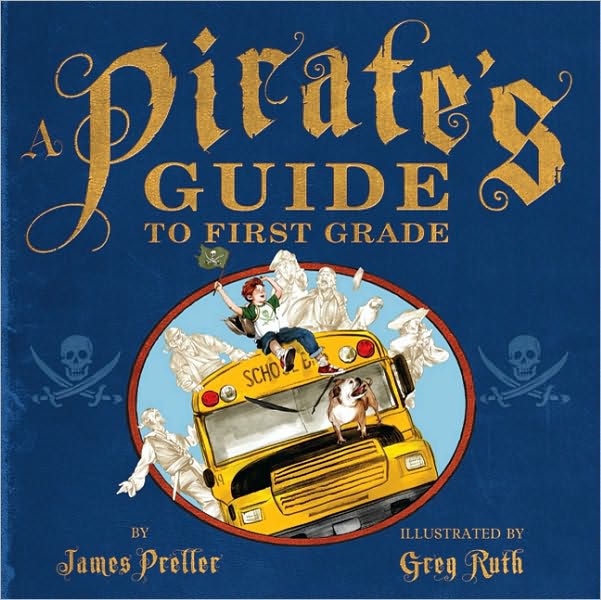
 A Pirate's Guide to First Grade written by James Preller, illustrated by Greg Ruth (2010)

Add this to your collection of "first day of school" books to read and share with teachers. I love it because of its potential to jump right in with a discussion of how illustrations tell a story separate from yet complementary to the text. Yes, it's a book about a boy's first day of school, but on this journey, he brings with him a crew of pirates, drawn in sepia-like tones while the rest of the story is done in watercolor oilstick and pastels. Are the pirates really there or not? Students will catch on to the fact that they are a figment of the boy's imagination. The text is done in pirate-speak but the endpapers provide a glossary, and of course, the illustrations show what may get lost in translation.


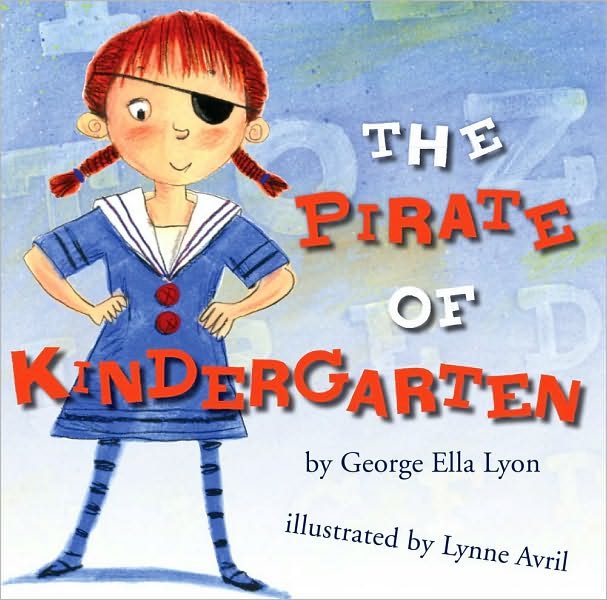
The Pirate of Kindergarten written by George Ella Lyon, illustrated by Lynne Avril (2010)

This one's not actually about pirates, but since it has pirate in the title, I thought I'd share anyway. Ginny always has her nose in a book, quite literally, and has trouble making out which bunny ears to cut. During her vision screening at school, she finds out that most people don't see two of everything like she does, so she goes to the eye doctor to fix her double vision - hence the eye patch. I like how the eye patch at the end turned her into a pirate, which was something positive and special for her. Great readaloud for kindergarten students before their own vision screening at school.

Other pirate favorites:
How I Became a Pirate written by Melinda Long, illustrated by David Shannon (2003)
Pirates Don't Change Diapers written by Melinda Long, illustrated by David Shannon (2007)
Henry & the Buccaneer Bunnies written by Carolyn Crimi, illustrated by John Manders (2005)
Henry & the Crazed Chicken Pirates written by Carolyn Crimi, illustrated by John Manders (2009)

Natalie

Wednesday, January 12, 2011

MLK Day Read-alouds

Martin Luther King Jr. Day is a big deal around here.We have a special section in the library devoted to books about him (because goodness knows there are a zillion books published about Dr. King), and teachers have been checking them out all week. Just in the nick of time, one of my book orders came in today with four new books that I couldn't wait to read and share. :)

Coretta Scott / poetry by Ntozake Shange, paintings by Kadir Nelson
published January 2009 by HarperCollins

I absolutely love the paintings in this book! I love how they take up an entire two-page spread and are vibrant and, in some cases, larger than life. You can see this by the cover alone. The poetry puzzled me. There is no punctuation, which frustrated me and had me stumbling over my words as I read it aloud to myself. The words per page are sparse and let the artwork tell the story too, which highlights Coretta's childhood, marriage, and key events in her life. I learned that she went to school to sing, and the last page has her and Martin singing together cheek by cheek, my favorite painting in the book. So pleased with this book and plan to share it with students when we study the Coretta Scott King Award.

My Uncle Martin's Big Heart by Angela Farris Watkins, illustrated by Eric Velasquez
published October 2010 by Abrams

Yes, this book is written by one of Martin Luther King Jr.'s nieces. And that's what I love about it - its conversational tone and portrait of a man who we all know as someone who did Great and Important things for society but who she just knew as a loving uncle. Love the illustrations in this one too - similar style to Coretta, but what I like most is that many of them are ordinary. There's one of Uncle M.L. asleep on the couch (fully dressed and with shoes!), one hanging out in the backyard with all the kids, and another smiling as he sends a telegram. It's nice to see another side of him, one that isn't so solemn and serious (though of course there's some of that too). This would be a good choice to share with the little ones.

Martin Luther King Jr. by Joeming Dunn, illustrated by Chris Allen
published July 2008 by Magic Wagon

This book is part of a graphic novel biography series, but do not be fooled, it's not a graphic novel. Not in the sense of the word as I know it, at least. While the illustrations are drawn as comics, the story is narrated completely rather than being driven by dialogue. And it's not really a story either, as it's written very much like an informational book about Dr. King, with chapters for his education, the Montgomery Bus Boycott, the March on Washington, etc. That being said, I think this will appeal to students who wouldn't normally pick up a biography or any informational text, the students who read comics exclusively (and I have plenty of those), and who will read anything as long as it's shelved in the 741.5s. So now I have a dilemma - where do I shelve it?


Sit-In: How Four Friends Stood Up By Sitting Down by Andrea Davis Pinkney, illustrated by Brian Pinkney
published February 2010 by Little, Brown

Oh, how I love this book! I am just consistently amazed by the Pinkney family - they have talent oozing out of their ears, they really do. I think I may have cried when I first read this book. It's so powerful in such a quiet way. Sprinkling Dr. King's words throughout, we are told the story of the Greensboro Four, the first four black students to sit down at a whites only Woolworth's counter and ask to be served donuts and coffee. It tells the story of King's nonviolent, peaceful approach to affecting change, using the metaphor of baking bread. Brian's watercolor and India ink illustrations are a perfect match for this story, but I couldn't tell you why. Perhaps because of the contrast between the delicate watercolors and the harsh black lines - the rightness of blending the two to create something beautiful though not clearly defined. I also love the added material at the end - a Civil Rights timeline, a note from Andrea about her research, and a bibliography of books and websites (selected by ALSC!) to consult "for further enjoyment." Gush gush gush. I love it. Definitely use it with 4th/5th grade students - and be surprised by the great discussions you will have.


Natalie

Tuesday, October 19, 2010

Monster picture books

The Scariest Monster in the World written by Lee Weatherly, illustrated by Algy Craig Hall
published September 2009 by Boxer

This monster would be hugely scary if he didn't have one little dilemma - he has the hiccups. And the poor thing just doesn't know what to do about it! He tries everything he can think of, but there's one cure that he can't try on his own - scare the hiccups away! Looks like he'll need some help with this one...
Big Scary Monster by Thomas Docherty
published July 2010 by Candlewick

Big Scary Monster loves to play BOO! at the top of the mountain where the animals are small and afraid. But they've learned to hide from the monster, so he wanders down the mountain to find other animals to scare. Trouble is, the animals at the bottom of the mountain are rather large and like to play BOO! too. Frightened away, the monster heads back up the mountain in search of someone to play with. Lucky for him, the animals are understanding and know that he just needs a friend.

Leonardo the Terrible Monster by Mo Willems
published September 2005 by Hyperion

Is this everyone's favorite lovable monster book? It sure is mine! Leonardo is, you guessed it, a terrible monster. He's never been able to scare anyone. Until one day. He spies a weak-looking boy, and he finally works up the courage to do it. He scares the tuna salad right out of this boy! Success! But he's not feeling very good about himself. Indeed, he decides it might be better to befriend the boy instead of scare him.
Even Monsters Need Haircuts by Matthew McElligott
published July 2010 by Walker & Co

This book has been making the blog rounds and for good reason. What a wonderful idea for a monster story! In a very matter-of-fact tone, we meet a boy who has inherited his father's profession, that of a barber. But the boy's shop is only open at nighttime, when the monsters come out, because, hey, monsters need haircuts too. The monsters are generally wary of humans but they know the boy well, so he's okay. Except that one night, it seems that a human stumbles in for a haircut... How will the monsters react?

The Monster Princess written by D.J. MacHale, illustrated by Alexandra Boiger
published August 2010 by Simon & Schuster

Every little girl wishes she could be a princess, and monster little girls are no exception. Lala the gnome sets out for the castle and finds the princesses' room empty - oh, what luxury! She tries on dresses and jewels and stares at her pretty reflection in the mirror. But when the princesses discover a monster in their room, they are none too happy... until Lala shares how much she'd like to be a princess just like them. A sweet story with a "love yourself" message at the end.

Welcome to Monster Town by Ryan Heshka
published July 2010 by Henry Holt & Co

When the sun sets, it's time for the monster day to begin. Each page describes "a day in the life of..." - for example, "The ghost writers cover the news" and "King Kong climbs tall buildings as he makes them." Interesting premise and vivid illustrations, but I wished for more of a storyline.


Got any monster favorites of your own? Please share!

Natalie

Monday, September 20, 2010

Pop! The Invention of Bubble Gum by Meghan McCarthy

Pop! The Invention of Bubble Gum by Meghan McCarthy
published May 2010 by Simon & Schuster
40 pages (hardcover), children's nonfiction picture book

How do I express adequately how much love I have for this book? But it's not the gleeful, jumping up and down kind - it's the quiet admiration of a job well done. So well done that I'm a little bit in awe.

The subtitle of this book gives it away - it is the story of how Walter Diemer persevered to create the perfect bubble gum. The topic will be an instant hit with kids, but what I love most about this book is how it tells a story by using actual quotations. No need to put this book in your picture book section, it's as real as they get. Every quotation is cited! And can we talk about the illustrations, please? The sweet, bubble-gum flavored, acrylic illustrations perfectly evoke the 1920s in color and style. And not only is it perfect for a read-aloud, but this is also a book the little ones could read on their own, with just a little help from an adult.

I am so happy when I find a nonfiction book that I enjoy because let's face it, nonfiction has a tendency to either be too dry or tries too hard to appeal to the kiddos. This book is neither - it's confident in its subject matter and tells the simple story of bubble gum's beginning. There is added material at the end for those wanting to know more about Walter Diemer and gum in general.

Check out the Nonfiction Monday Wrap-Up at Wrapped in Foil!

Natalie

Saturday, September 18, 2010

First grade wonders

I've been teaching first grade students the difference between fiction and nonfiction for the past couple weeks, and this week's lesson involved a reading of each type of story. It's no secret that I prefer fiction - I love made-up stories, especially fantasy, so I share that love often. But I may be doing things a little differently from now on.

Beware of the Frog by William Bee
published June 2008 by Candlewick
48 pages (hardcover), picture book

Sweet little old lady, Mrs. Collywobbles, is afraid of the "big, dark, scary wood" near her house - but luckily, she has her pet frog to keep her safe. Monsters leave the forest en route to Mrs. Collywobbles house (goblin, troll, ogre) but are gobbled up by her pet frog before they can make any trouble. In a surprising twist of events, Mrs. Collywobbles gives her pet frog a little kiss of gratitude and is transformed into a frog herself! Whatever will she do?

The kids loved this book - all three classes of first grade students ended this story with a chorus of "Read it again!" Of course it helped that I love this book and used all kinds of creepy, scary voices for the monsters. It was good choice for the fiction side of things because although little old ladies may have pet frogs, 1. their frogs don't eat monsters and 2. humans can't change into frogs. This was an easy concept for some students to grasp - others alluded to The Princess and the Frog, and I had to remind them that that was a made-up story too. But all in all, they were pretty good about telling each other why this book was fiction.


Frog by Moira Butterfield
published October 1991 by Simon & Schuster
24 pages (hardcover), children's nonfiction

Frog is the story of the life of a frog, from egg to tadpole to full-grown frog. Each page has a single sentence with clear illustrations. It's a small book. It's simple. It's easy to understand.

And the students were mesmerized. I read each word slowly and fanned the book to show the illustrations. Not a peep from the children. They were leaning forward, completely captivated by what I was showing them, which totally shocked and confused me. It was so quiet in the library that when I finished the book, I used my whisper voice and asked if this was fiction or nonfiction and why. Students raised their hands and gave articulate responses. Well, knock me over with a feather! I'm only surprised because the previous story brought out the silliness in students and this one sobered them up so quickly. Bad librarian for being so biased! Nonfiction is interesting to the little ones, so I've witnessed. I'll have to bring more of it to my library lessons.

Natalie

Monday, June 7, 2010

Jack and the Beanstalk

Today was the last official day of school, and even though I've done a TON of outside reading, my mind is still there. For the past month, I've been reading Jack and the Beanstalk stories to third grade students. They all knew the story already, of course, but we read two different versions, and then ended with a readers' theatre.

I began with E. Nesbit's retelling of Jack's story, with pencil and watercolor illustrations by Matt Tavares. This is a hefty book - a thirty-minute read-aloud, in fact. Because it delves deeper into Jack's story than I remember ever reading before. We learn about the land in the sky where the giant lives, told by a fairy who serves as a guide to Jack on his first trip up there. Jack's father had opposed the giant long ago and was killed by him for it. Thus, Jack's killing of the giant at the end of the story serves to avenge his father's death. Originally written in the early 1900s, this version is dated, of course, with references to trousers and I can't think of what else, and the language is rather flowery, if you will. It begs to be read aloud, but it requires a patient and attentive audience. But the full-color, full-page illustrations make up for what may be lost in translation in the text. Personally, I loved it, and I think some students appreciated it as well.

However, most students were instead fans of Waynetta and the Cornstalk: A Texas Fairy Tale by Helen Ketteman and illustrated by Diane Greenseid. Perhaps it was the silly accent I used (native Texans would most certainly be appalled by it) or the bright, vibrant illustrations, or the cowgirl feel to the story, but I definitely saw a difference in engagement with the book - students loved this one. In this version, Waynetta must sell the last longhorn in order save the family ranch, meeting a man along the way who trades her some magic corn, hence the cornstalk. Instead of a hen that lays golden eggs like in Jack's story, Waynetta finds in the giant's possession a cow who produces (or excretes, rather) golden cowpats. We also have a magic lasso as well as a magic bucket, whose uses are better suited to the setting of this story. What I most loved about reading this book was the natural comparisons that students made to Jack's story which we read the week before. Yep, it was Venn diagram time.

Honestly, I could have read Jack and the Beanstalk stories to third grade for weeks on end. But I stopped there because they get a little antsy after hearing the same story multiple times. For the next two weeks, we worked on a readers' theatre of the story, adapted by Lisa Blau. I enjoyed this script because it has eight parts, which meant that I could have two groups of students in each class and every student would have a speaking part. Overall, they did a great job, even though we could have used more time and probably a little more direction from me. Thirty minutes is just not enough time for readers' theatre, in my opinion.

So, that's all the Jack that my students got to see. But I have to tell you that I read many more versions of this tale, some of which I'm sure I'll forget to name.

Jack and the Beanstalk by Richard Walker
my thoughts via Goodreads:
This version intrigues me because of its jewel-toned color palette and Tim Burton-esque (think Nightmare Before Christmas) illustrations - so different from the typical greens and browns and realistically drawn scenes in most Jack books. But the story is chopped up - Jack only visits the giant once, with the goose and the wife following him back down the beanstalk and the giant soaring into space.

Jack and the Beanstalk by John Cech
my thoughts via Goodreads:
These watercolor illustrations make me smile, they're so vivid! For a contemporary take on an old tale, this one might be my favorite. I appreciate the repetitious Fee Fi Fo Fum rhyme of the giant's, and the three trips Jack takes up the beanstalk. In the end, the giant's wife comes down the beanstalk with Jack, they cut the stalk down and feed it to the cows, and the giant is still stuck up in the clouds (the only sore point for me - I wish the giant was killed). While Jack still has a few magic beans left in his pocket...
Some others that I just didn't feel like delving into, but that I know students also enjoy...

Kate and the Beanstalk by Mary Pope Osbourne

First grade girls love this one. The gender switch is obvious, but apparently the rest of the story is pretty close to the original. Not that I would know because I have not read it. It's always checked out!


Paco and the Giant Chile Plant by Keith Polette
Set in the Southwest, this Jack tale is told in both English and Spanish, and boy, does it have a lot of flavor! It reminds me of The Runaway Tortilla in its infusion of Latin culture to a traditionally American tale.


Jack and the Beanstalk: The Graphic Novel by Blake Hoena
I love the Graphic Spin series by Stone Arch Books. They're kind of like easy readers but in a graphic format, which really appeals to kids. I haven't read this one, but I am sure glad it exists.


Okay, do you blame me for saving Calamity Jack by Shannon and Dean Hale for last? I just don't know what to say about it. It defies everything I think about graphic novels. Even though I read and like them, I still have preconceived notions of what they should be or what they normally are, and this one just doesn't fit - in a good way. Perhaps it's just because I don't read too many original graphic novels, meaning quite literally, original novels in a graphic format. The story is so creative and clever - oh, how I was laughing aloud! And I can't, no, I won't describe it for you because it's not so much about the story but more about the full experience of taking in the characters, the setting, the gorgeous illustrations by Nathan Hale, and also, the ridiculous story. Giant, man-eating ants? Yes, it's ridiculous. But Jack's original story is interspersed throughout this fantastic creation - you definitely have to search a bit to uncover it though. My students loved Rapunzel's Revenge, so I'm wondering how they'll respond to Jack's story.

Okay, that's enough of Jack and the Beanstalk for one day. Unless you have a favorite I haven't mentioned to share. Please do share!

Natalie

Thursday, April 15, 2010

Picture books

The Squeaky Door retold by Margaret Read MacDonald, pictures by Mary Newell DePalma
published January 2006 by HarperCollins

Based on a Puerto Rican folk song, this is the story of a little boy who has trouble sleeping in his big bed all by himself. His grandma tucks him in and asks if he'll be okay, and he insists that he'll be fine - only to start wailing when she closes the door. To help him sleep, one by one, the animals in the house (and on the farm!) join him in bed, but as soon as the door squeaks closed, the boy and the animals are crying and making noise. In the end, the boy sleeps with his grandparents for a night, grandma fixes the squeaky door, and just the cat sleeps with the boy at night.

This one would be great for a unit on "What are you afraid of?" or paired with a similar book like The Napping House. Or even with more Latin American folktales. There are many directions to go with this one! It is very repetitious and students will definitely want to read along (and make the animal sounds) by the middle of the story. I would use it with K-2 students, depending on the theme.

Rhyming Dust Bunnies by Jan Thomas
published January 2009 by Simon & Schuster

Silliness abounds in this book, in a slightly sophisticated way. Four dust bunnies are hanging out (Ed, Ned, Ted, and Bob), finding rhyming words because that's what they like to do, but one of them (you can guess who) is never able to come up with a rhyming word. Well, it turns out that he's trying to warn the rest of the group about a monster with a broom ::shudder:: and later a vacuum! The text is sparse, with only cartoon bubbles from the dust bunnies and the illustrations are large, filled in with solid colors. It's a clever little story that could serve as a fun introduction to rhyming words and/or poetry.

Splat the Cat by Rob Scotton
published July 2008  by HarperCollins

It's Splat the Cat's first day of school. He's scared senseless and tried everything he can to stay home. Alas, he gets to school, and he finds that it's not so bad. The class greets him with a warm welcome, and he learns that cats are actually pretty amazing creatures. But the one thing Splat learns that he's not so sure of is that cats chase mice. See, Splat likes mice and befriends one in the class, who just so happens to be able to open the milk closet and who changes the minds of all the cats to like mice too. I really loved this book, but the mouse sub-plot was too reminiscent of Despereaux to me. Nonetheless, the illustrations are absolutely fantastic - the furry, fuzzy cats look like they pop off the page. This is a great "first day of school" book that I would share with K-2.

Natalie

Wednesday, April 7, 2010

Read-alouds in the Library

Because I am now gainfully employed (at least for the next two months), I have a lot less time on my hands, and most of what I've been reading lately is to share with my students. And now I'll share them with you...

Duck on a Bike by David Shannon
published  April 2002 by Scholastic

So, I'm doing a David Shannon author study with first grade students. Last week, we read Too Many Toys and The Rain Came Down. Eventually, I'll get to the David books (though I'm not really a fan), but today was definitely a Duck on a Bike day. Sometimes I just want to jump for joy at how a great book can captivate and inspire a group of students.

If you don't know the story, Duck rides a bike around the farm, and on each page he encounters an animal who reacts to Duck's unusual activity (Dog is excited, Mouse is jealous, Sheep is wary, etc.) with an animal sound and an exclamation. In the end, a group of children conveniently leave their bikes outside the house, and all of the animals on the farm get to ride a bike for a short time.

There are many factors which contribute to a great read-aloud - many of which have nothing to do with the reader or the book. Time of day, weather, lunch, recess happenings, etc. Those seemed to all be in my favor today because my students came in quietly, sat down in their neat, little rows, and listened to the story. I asked them to raise their hands every time a new animal was introduced, and they did! With enthusiasm! They asked good questions, gave thoughtful answers, and were just wonderful. We got a little silly at the end of class; I read the book again, but this time I asked them to contribute the animal sounds. Yeah, they love that.

Hansel and Gretel retold and illustrated by Rachel Isadora
published April 2009 by Penguin

Grimm's tales with fifth grade = a lot more fun in theory. I was so excited to share these gruesome, scary versions of everyone's favorite fairy tales - except that kids today don't know the fairy tales at all. Last week, I read Cinderella, but before I did, I asked students to retell it for me, just basic plot points. Yeah, that wasn't happening. I got the Hillary Duff A Cinderella Story version, with a cell phone left behind at a high school dance. Really? Really?! Do I have to suck it up and admit that fairy tales are on their way to being obsolete? Am I supposed to thank Disney for keeping them alive as long as they did? I digress.

This week, I read this AMAZING retelling of Hansel and Gretel. Rachel Isadora stayed true to Grimm's story, but she set it in Africa with bright, bold colors in a collage style - and a green, nasty-looking witch. I immediately fell in love with this book. There's nothing in the text that specifies setting, so I'm thrilled that Isadora just made it up and stuck with it. I hear that she's quite good at this. I hoped that my excitement would be contagious and that students would really get into the story and especially appreciate the illustrations. Not so much. What can I say? Grimm's tales are repetitive (in keeping with the oral tradition) with some interesting morals, and well, a little boring. It takes a lot to entertain these students, and they just weren't having it with this story.

But the point of the lesson was to compare two retellings of the same story to see how time and perspective can introduce many variables to essentially the same text. But I need more than 30 minutes for this. And I need students who care. I don't know how to make them care. They just see it as something they need to get done - another worksheet to fill out (or not, as the case was for many of them). Is it just that it's spring and they're tired of school and perhaps a little jaded and ready to leave elementary school behind? I sure hope so.

What Happened to Marion's Book? by Brook Berg, illustrated by Nathan Alberg
published September 2003 by Highsmith

Kindergarten is absolutely my weakness. With over 20 five year-olds and just one me, I have trouble reading a story and checking out books in just 30 minutes. This book is lengthy but a good review of how to care for a book, especially at this time of year when books are coming back sopping wet ("I left it in the rain") or chewed up ("It was my dog").

Marion the hedgehog loves to read and has lots of books of her own. When she starts school, she gets to borrow two books from her school library, and she decides that she wants to be a librarian when she grows up (yes, it's a little cheesy). One day, while Marion is reading her library book at the breakfast table, a big glob of jam falls on a page. Oops! Marion knows that her librarian will be disappointed if she brings back a dirty book, so she decides to clean it. Her dog licks it, she puts toothpaste on it, takes it in the bath, and puts it in the washer - until the book is completely ruined. Moral of the story - 'Fess up right away and all is forgiven (well, you know, except that fine you'll have to pay).

Students were truly shocked at the choices Marion makes during the course of the book (thank goodness!), and I think they'll remember to keep their books clean and dry. Now if I can get them to bring back their books at all...


That's all for read-alouds this week. Third grade is working on using the online catalog, and fourth grade is using magazines for information. More next week!

Natalie

Monday, February 1, 2010

Nonfiction Monday: Sojourner Truth's Step-Stomp Stride

Sojourner Truth's Step-Stomp StrideSojourner Truth's Step-Stomp Stride written by Andrea Davis Pinkney and illustrated by Brian Pinkney
published November 2009 by Hyperion
32 pages (hardcover), picture book

I am not an avid fan of nonfiction, but I do happen to like narrative nonfiction. Tell me a story - and if it's true, I'll try not to hold it against you. So, I was delighted to find this little gem of a book in my library's new children's nonfiction section.
She was big. She was black. She was so beautiful.
This is the beginning of Sojourner Truth's story. What a hook! I am very much in love with what this husband-wife duo has produced here. Truth's story is told conversationally from her birth to her "Aint I a woman" speech" - and what ties it all together is her shoe size. Those size 12 feet stomped on the beetles on the farm in her childhood and would stomp on ignorance and injustice in her adult life. And that's the way a successful, interesting, kid-appealing nonfiction picture book is written - with flavor and style and a bit of pizzazz. Yes, I said pizzazz. Brian Pinkney's watercolor and ink illustrations are gorgeously soft and evocative - no complaints here in the picture department. But Andrea's text is what captured me - and that is a rare occurrence in a picture book that I particularly enjoy. I am generally drawn to illustrations and am often let down by boring writing. But there are no letdowns here! The text works so well with the illustrations - they are inseparable. In a scene where Truth is walking across many fields of greens and yellows with a large, swirling sun overhead, Pinkney writes:
Belle soon learned that to celebrate freedom, she had to speak her beliefs [...] Freedom meant she would 'travel up and down the land' to share her ideas. That's when Belle changed her name. She gave her slave name the boot, and called herself Sojourner Truth. She said the name Sojourner was just right for someone who was a traveler. And Truth--well, that was what Sojourner did best--she told it like it was.
Oh, I just love it! Go and read it for yourself!

Nonfiction MondayAs it is the beginning of February (hooray!), I am reminded that it is Black History Month. Because I know that local schools celebrate in various ways, I am happy to share this book today since it would be an excellent read-aloud for the elementary set. Though the inside flap reads "Ages 5-9," I probably wouldn't go younger than third grade, which still seems a bit young to me. Definitely for fourth and fifth grade. Background information about the times may be helpful before reading this book to students. Maybe a discussion about what freedom means to students too. Or looking up the word "sojourner" in the dictionary. There is certainly plenty that can be done with this book!

Nonfiction Monday is hosted at Wild About Nature this week. Check it out for the roundup of posts!


Natalie

Sunday, December 13, 2009

Lion, Mouse, Ogre


The Lion and the Mouse
written and illustrated by Jerry Pinkney

Displayed above is a side-by-side view of the front and back covers of this book. Generally, I'm not fond of covers without title and author information, but I will make an exception for Mr. Pinkney. This wordless picture book of Aesop's fable "The Lion and the Mouse" is in fact exceptional, and there's nothing else for me to say about it. Go buy it. I think I will too.

And then there's Awful Ogre, who warms my heart in an entirely different way. I first read Awful Ogre's Awful Day written by Jack Prelutsky and illustrated by Paul O. Zelinsky about four years ago when I was student teaching in a third grade classroom. I read it aloud to my students, and they gobbled it up. They loved it so much that it inspired us to explore poetry for the next month or more. I recently shared it with my third grade students in the library, which received mixed responses. Nonetheless, I love this book of poetry and wanted to share my enthusiasm for it with a new group of students.

So, how excited was I to find that there's another Awful Ogre book that I have yet seen?! Pretty darn excited, let me tell you. I snatched it up from my free library's new books section and took it home to read aloud (because you have to read poetry aloud!). Awful Ogre Running Wild is indeed a companion book, written and illustrated by the same duo, and it is just as much fun as the first. In fact, there are many parallels between the two books, which makes them very useful for lessons on poetry in the classroom or library. Not having Awful Ogre's Awful Day in front of me, the most obvious correlations I could make were the following:

Running Wild
  • "Awful Ogre's Picnic" with his girlfriend
  • "Awful Ogre Enters a Cook-Off"
  • "Awful Ogre Pays a Visit" to his grandma
  • "Awful Ogre Stays at an Inn"
  • "Awful Ogre Has Insomnia"
Awful Day
  • AO writes a letter to his ogress girlfriend
  • AO wins a gardening contest
  • AO's great-grandnephew (or something of the sort) visits him
  • AO goes out to eat at a restaurant
  • AO dreams
The one problem I have with this new book, however, is that there are some poems that take up four pages instead of a two-page spread. I expected the poem to end, but then I turned the page and there was more! But that's not much to gripe about, eh?
 
Copyright 2009 This Purple Crayon. Powered by Blogger
Blogger Templates created by Deluxe Templates
Wordpress by Wpthemesfree